Audi A5 Series refreshed for 2012

Audi is rolling out the 2012 version of the A5 series that will come with several technological and cosmetic updates to the Sportback, Coupé, Cabriolet and S5 models.
Under the hood the A5 has the completely redesigned 1.8 TFSI with updates that can be found in the control of the valves and their lift, the thermal management concept, the injection system, the turbocharger and the integration of the exhaust manifold. In the A5 Coupé, the high-end four-cylinder unit consumes on average just 41.27 mpg. The output of the 2.0 TFSI remains unchanged with 211 hp. New to the Audi A5 lineup is the 3.0 TFSI, a supercharged V6 producing 272 hp.
At the top of the line are three V6 diesel units. The 3.0 TDI with 204 hp is the most fuel-efficient six-cylinder unit in its class worldwide. In the A5 Coupé with multitronic, it gets an average of 48 US mpg. The second variant of the 3.0 TDI produces 245 hp.  Arriving in the near future is a low-emissions clean diesel model that will make the A5 the first coupe on the market to meet the Euro 6 diesel standard.
A manual six-speed transmission and the continuously variable multitronic are available for models with front-wheel drive. The quattro models come with a manual transmission or the lightning-fast, seven-speed S tronic. Models of the A5 family equipped with quattro permanent all-wheel drive and the S tronic transmission also feature the crown-gear center differential with torque vectoring. During normal driving, the mechanical component sends the engine’s power primarily to the rear wheels. When needed it redistributes the power lightning-fast and smoothly. Up to 70 percent can flow to the front axle, 85 percent to the rear axle. Torque vectoring uses targeted, minor braking interventions to make the handling even more precise.
The A5 has a five-link front suspension and the trapezoidal-link rear suspension are made of aluminum. The rear suspension bearings and the damper tuning have been updated for more precise handling and even greater comfort.
The ESP stabilization program with electronic limited slip differential is standard in all front-wheel drive versions of the A5. ESP uses minimal braking interventions at the inside front wheel for even more agility during dynamic driving. The large brakes – with ventilated front and rear discs in many variants – offer excellent stopping power and are very easy to modulate.
The A5 comes with 17-inch wheels with 225/50 tires as standard equipment. Options include wheels up to 20 inches and 265/30 tires as well as four new wheel designs.
Among the high-end features in the model series is Audi drive select. In the basic configuration, it adjusts the power steering boost, the accelerator characteristic, the shift points of the automatic transmission and the automatic air conditioning. Using a button in the cockpit, the driver can determine whether these components should work in “comfort,” “auto,” “dynamic” or “efficiency” mode. The latter helps to drive the A5 particularly efficiently. If the car is equipped with a navigation system, there is also an “individual” mode that the driver can largely configure him or herself.
Another new standard feature in the A5 model series is the electromechanical power steering. An electric motor generates the right amount of boost for the speed being driven. The electromechanical power steering features a direct ratio, reacts instantly and provides precise road feedback. It intervenes slightly to support the driver when braking on a surface with less grip on one side of the car.
From the curb changes in the exterior of the A5 include the upper corners of the single-frame grille are now in high-gloss black are beveled. The grille’s lateral bars and the Audi rings appear to be sculpted. The new bumper features pronounced air inlets with massive struts, revamped grilles and flat fog lights. Sharply chiseled edges give the engine hood a three-dimensional look; the entire front end appears even flatter and wider.
The headlights have also been updated. Their lower edge forms a wave while their interior has been restructured. With the optional xenon plus headlights, the LED daytime running lights form a narrow, homogenous clasp framing the headlight. Audi also offers the adaptive light system with dynamic cornering light and turning light. The rear lights have also been redesigned and are optionally available with continuous LED light strips. The bumper includes a number of additional details.
The updates have added a 0.04 in to each of the exterior dimensions. The A5 Sportback is 15.45 ft long; the Coupé and the Cabriolet 15.19 ft. The range of colors has been reshuffled and now comprises 16 colors. The fully automatic acoustic top of the A5 Cabriolet is available in four colors. The S line exterior package is available for those who appreciate an even more dynamic look.
Inside, updates include new steering wheels, including an option for a flattened ring, new steering column stalks and with narrow chrome clasps framing the control elements. A button is used to directly adjust the optional seat heating and seat ventilation in three stages. Also updated were the ignition key, the selector lever for the automatic transmission, the button for the optional Audi drive select system and the controls of the high-efficiency air conditioning and multifunction steering wheel. All displays are now illuminated in white.
New paint covers the bezels on the instrument cluster and the center console, and there is also a new selection of upholstery and inlays. The latter are available in Aluminum Trigon or in walnut or natural fine grain ash. Almost all of the interior colors are new. Fine Nappa leather replaces Valcona in the Sportback, and the armrests can also be covered in leather, if desired. The A5 Sportback is also now optionally available as a five-seater.
Buyers looking for that special something will find many more customization options in the Audi exclusive range, including the stylish Audi exclusive line with two-tone seat coverings.
The infotainment systems in the A5 have been significantly upgraded. Audi equips all models in the A5 lineup with a CD radio and eight speakers.
The optional top-of-the-line unit is MMI navigation plus with a large hard drive, seven-inch color monitor, 3D graphics and DVD player. Its controls have been improved. The number of hard buttons has been reduced from eight to four and the volume control now features a joystick cap to make it easier to choose songs. Voice control and digital radio reception also received some fine-tuning.
An additional option is the Bluetooth online car phone. Audi connect is the catchword for the attractive services this phone brings to the A5, which include Google POI search, navigation with Google Earth images and a WLAN hotspot. The hotspot enables passengers to surf the Internet and send and receive e-mail with their mobile devices. Audi traffic information online is an additional service that does a much better job than the familiar TMC standard of providing the driver with extremely precise and current information about the traffic load along the selected route. All the driver needs to use these functions is a data-capable SIM card.
The assistance systems in the Audi A5 model series use a variety of technologies to make driving even more controlled. Some of them have been improved with new functions. Among the standard features is the new driver information system with recommendations to take a break. It uses steering motions and additional parameters to detect when the driver is getting tired and issues an appropriate warning.
Audi side assist supports the driver when changing lanes by using radar to monitor the space behind the car. Audi active lane assist – a new feature in the A5 – helps the driver to maintain the lane. A camera detects the lane markings and the system makes slight corrections to the electromechanical steering, if necessary. The adaptive cruise control uses radar technology to maintain a constant interval between the A5 and the vehicle ahead. At speeds below 30 km/h (18.64 mph), it initiates maximum braking in the event of an impending collision.
The top models in the series, the S5 as Sportback, Coupé and Cabriolet have also been refreshed. All S5 models, including the Coupé, are now equipped with the 3.0 TFSI producing 333 hp. Compared to the 4.2-liter V8 it replaces in the Coupé, the supercharged V6 consumes on average 20 percent less fuel per 100 kilometers. Average fuel consumption is just 29.04 mpg while performance remains impressive. The S5 Coupé accelerates from 0 to 62.14 mph in just 4.9 seconds on its way to an electronically governed top speed of 155.34 mph.
Visual cues to the updated S models include new lights, modified body details and new crystal-effect paint finishes. Subtle changes can also be found in the interior. The most important technical updates for the Audi S5 are quattro drive with the crown-gear center differential and electromechanical power steering. The special S sport suspension and the standard 18-inch wheels deliver the power to the road.
Despite the extensive product improvement, Audi is raising prices only slightly. The base model, the Audi A5 Sportback 1.8 TFSI, costs $47,196.00 in Europe.
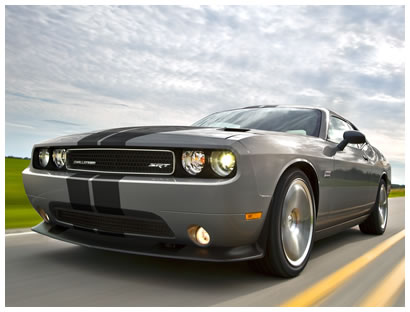
2012 Dodge Challenger SRT8® 392 brings 470hp and 23mpg to market

You got to be impressed when a car puts out 470hp while stretching a mile of gas for 23 miles so you got to impressed with the 2012 Dodge Challenger SRT8® 392. That 470hp will get you from 0-60 mph in the high 4-second range and down the quarter mile in the mid-12-second range with the automatic transmission and high 12-second range with the manual. To get from 0-100-0 mph takes less than 16 seconds while top speed is 182 mph with the manual transmission and 175 mph with the automatic. If you need to stop from 60-0 mph it will only take 117 feet.
For 2012, the Challenger SRT8's 392-cubic inch HEMI® V-8 delivers 470 horsepower and 470 lb.-ft. of torque. The torque band is extremely flat allowing for strong standing starts and improved straight-line performance throughout the rpm range. An advanced active intake manifold along with high-lift cam with phasing provides maximum low-end torque and high-end power while still delivering up to 23 miles per gallon on the highway with the standard manual transmission. Performance-tuned engine mounts improve idle stability and ride control at all speeds.
The impressive mileage is a result of Dodge's Standard Fuel Saver Technology in automatic transmission equipped models that allows the engine to operate economically on four cylinders or use the power of all eight cylinders when needed. The EPA fuel economy miles per gallon (mpg) (City/Hwy) ratings for the 2012 Dodge Challenger SRT8 392 are 14/22 for automatic transmission models and 14/23 for manual-transmission models.
The 2012 Dodge Challenger SRT8 392 features a standard Tremec TR-6060 six-speed manual transmission and a dual-disc high performance clutch – a proven performer that was first offered on the 2008 Dodge Viper SRT10®. The optional five-speed automatic transmission features new, standard steering wheel mounted paddle shifters that join the center console mounted Auto Stick. Both methods give the driver the ability to manually select specific gears on the transmission.
In “Drive,” the transmission controller will automatically shift the vehicle. The aggressiveness of the shifting is defined by the mode chosen - either “Normal” or “Sport.” Fully adaptive electronic control of all shifting makes the powertrain more responsive while minimizing harshness. In “Manual,” the shift method is defined by the driver choosing to use either paddle shift or Auto Stick. The “Sport” mode adds a hold function to the calibration in all gears, allowing the driver full control of the shifting schedule. 2012 Dodge Challenger SRT8® 392
New for 2012 is the adaptive damping suspension (ADS) system which is tuned specifically for the Dodge Challenger SRT8 392.  In “Auto” mode, a wide range of on-road and driver inputs – such as vehicle speed, steering angle, steering speed, brake torque, throttle position and lateral/vertical accelerations – automatically tune the suspension for specific conditions. In “Sport” mode, the damping system rebound and compression is locked to the higher damping rate. Drivers can easily choose between settings to quickly change the shock damping and harshness characteristics from “Auto” for everyday commuting to “Sport” for more spirited driving situations.
The SRT rides a half-inch lower than other Challenger models and rides on either the standard five-spoke, 20 x 9-inch fully forged aluminum wheels or available seven-spoke, 20 x 9-inch lightweight forged aluminum wheels with satin black painted pockets. Standard Goodyear RSA All-Season tires or available Goodyear F1 Supercar Three-Season complement the performance design cues and improve performance and handling.
Stopping all this performance is the standard SRT performance brake package produces a stopping power of 60 to 0 mph in just 117 feet from 14.2 inch (front) and 13.8 inch (rear) vented/slotted rotors with four-piston Brembo fixed calipers painted red. The three-mode electronic stability control system with knockback mitigation also includes four-wheel ABS, all-speed traction control, electronic brake-force distribution, Brake Assist and Hill-start Assist (HSA).
From the curb the 2012 edition of the STR8 remains largely unchanged. There is a large front splitter, integrated front fender spats, body color rear decklid spoiler and the front fascia chin spoiler which is accented in black for a more aggressive look. The front grille features a bright grille surround.
For 2012, available exterior colors include: Bright Silver, Bright White, Header Orange, Pitch Black, Redline Red and Tungsten Metallic. Dual, full-body stripes are available in black, grey metallic, red and silver metallic. There are also “392 HEMI” badges flanking both fenders and from the rear there are 4-inch rectangular exhaust tips.
Inside Dodge is touting a race-inspired interior with new, leather wrapped, heated, SRT-exclusive steering wheel that features a satin chrome rim section with a flattened bottom surface that showcases the SRT logo. The optional automatic transmission includes paddle shift controls on both sides of the new contoured palm rests. All audio and Electronic Vehicle Information Center (EVIC) controls are accessible from the horizontal spokes on the steering wheel.
The trapezoidal instrument panel features a four-bomb gauge cluster with chromed accent rings and unique SRT graphics. Inside the cluster, the SRT-exclusive Electronic Vehicle Information Center (EVIC) with performance pages provides the driver with trip information, multimedia information from the Media Center radio, along with instant feedback on 0-60 mph time, 60-0 mph braking, G-forces, one-eighth mile and quarter-mile times.
New for 2012, the Dodge Challenger SRT8 features an available 900-watt, 18-speaker premium SRT performance audio surround-sound system from Harman Kardon. The system offers world premier innovation, featuring a 32-volt TPS (Tracking Power Supply) 12-channel Class D amplifier that delivers outstanding acoustics and brings multi-dimensional, quality sound for all interior occupants.

Ferrari FF Tears Up The Goodwood Festival of Speed Hill Climb


James Martin, famous TV personality and celebrity chef piloted the Ferrari FF during the famous 1.16-mile long Goodwood Festival of Speed uphill race.
In the video, James Martin tears up the hill shifting gears like a mad man. The car seems to be very poised and balanced through the turns. At the end of the two minute long video Mr. Martin goes over the positive aspects of the Ferrari.
The FF is the successor to the 612 Scagliettei, offers a generous amount of cargo room, and has a wagon-like design. Even with its quasi-wagon body-style, the car sports a 6.3-liter V12 engine with 651-hp and 504 lb-ft of torque allowing a 0-62 mph time of just 3.7 seconds.
Check out the video and article after the jump!

2011 Hyundai Genesis: Value priced rear-wheel drive luxury sedan

Years ago, Hyundai was the new car of last resort — the cheapest new car you could buy. Hyundai has come a very long way since then, and the Genesis sedan is proof. It’s a high value, rear-wheel drive luxury sedan offering a choice of V6 or V8 power.
The Genesis seats five in a well-appointed cabin, featuring wood and aluminum trim, chrome accents, soft-touch materials and state-of-the-art technology. For example, while an iPod interface is standard, the voice-activated navigation system includes a multimedia interface that’s easier to use than what’s offered in most luxury cars, and there’s an optional 17-speaker audio system with 7.1 Surround Sound.
I originally drove this car when it was first introduced as a 2009 model, and was impressed then. This go around, driving the V8 version, impressed me even more.
Model Lineup: The 2011 Hyundai Genesis sedan is offered in two models — the Genesis 3.8 and 4.6. Both are named after the size of their powerplant.
The Genesis 3.8 stickers at $33,000 and comes standard with leather upholstery; leather-wrapped tilt/telescoping steering wheel with audio controls; dual-zone automatic climate control; cruise control; heated front seats; eight-way power-adjustable driver’s seat with lumbar adjustment; four-way power-adjustable passenger seat; heated power mirrors; power windows and door locks; remote keyless entry and starting; seven-speaker AM/FM/CD/MP3 stereo; iPod interface; XM Satellite Radio; auxiliary audio input jack; Bluetooth cell phone link; auto-dimming rearview mirror; compass; universal garage door opener; automatic headlights; theft-deterrent system; fog lights; and P225/55R17 tires on alloy wheels.
Options include a $2,500 Premium Package that adds premium leather upholstery; leather-wrapped dash and door trim; power tilt/telescoping steering wheel; memory for the driver’s seat, a sunroof; Lexicon 14-speaker audio system; six-disc CD changer; automatic windshield defogger; rain-sensing wipers; and a power rear sunshade.
The Premium Navigation Package ($2,000) adds P235/50R18 tires on alloy wheels with chrome inserts, 40-gigabyte hard drive navigation system, XM NavTraffic with a 90-day subscription, and rearview camera. The $5,500 Technology Package also comes with the larger wheels and tires; and includes front and rear park assist; Ultimate Navigation with hard drive; heated/cooled driver’s seat; 17-speaker Lexicon audio system with 7.1 Surround Sound, HD radio, rearview camera; smart cruise control; electronic parking brake, and adaptive, auto-leveling xenon headlights.
The Genesis 4.6 (our test vehicle) stickers at $43,000. There are no options. The 4.6 as it comes standard with all the standard and optional equipment from the 3.8, plus electro-hydraulic power steering, chrome bodyside moldings, illuminated door sill plates, woodgrain trim on the steering wheel, and auto-dimming outside mirrors.
Safety features on both include dual front airbags, front and rear side airbags, curtain side airbags, tire-pressure monitor, electronic active front head restraints, antilock brakes with brake assist and electronic brake-force distribution, traction control, and electronic stability control.
Walkaround: The Hyundai Genesis looks like someone sat down at the computer mixing and matching design elements from the Mercedes E-Class and BMW 5-Series. Styling isn’t really aggressive, but more pleasingly athletic. Except for a semi-discreet badge on the trunk, you wouldn’t know this was a Hyundai, and numerous people mistook it for a Mercedes.
The trapezoidal grille boasts a touch of Mercedes, flanked by modern eye-slit headlights. Fog lights are standard on the lower fascia, which also features a large lower air intake.
Overall, the car resembles the more angular shape of the BMW as opposed to the softer, rounder Mercedes design. The roofline mirrors the 5-Series, right down to the dogleg rear pillars.
The Genesis features a high trunk line and a lower fascia adorned with dual exhaust tips hinting at its sporty character.
Interior: The Genesis boasts a luxurious cabin, with soft-touch materials everywhere, including a leather-wrapped dash — something usually reserved for much more expensive vehicles — and chrome accents. The easy to read electroluminescent instrumentation features white numbers on a black background with blue accents.
The center stack includes a small screen at the top that displays radio and climate information, with radio controls at the bottom, and 10 buttons devoted to climate control. The CD slot sits below the center stack and below is a small cubby for CDs.
The front seats are comfortable and sit up high. Front and rear head and legroom are plentiful. The trunk is deep, with 16.0 cubic feet of cargo room.
Under The Hood: The standard 290-horse, 3.8-liter V6 puts out 264 pound-feet of torque. The Genesis 4.6 features Hyundai’s 4.6-liter Tau V8, which puts 385 ponies on the pavement (with premium gasoline; 378 with regular) and 333 pound-feet of torque (324 lb-ft with regular gas). Both engines are mated to 6-speed automatics with a manual shiftgate.
Behind The Wheel: Our test V8 delivered plenty of smooth power and offered pretty decent mileage (17/City—25/Highway) — especially for this performance level.
The Genesis benefits from rear-wheel drive architecture, a rigid structure, and advanced five-link front and rear suspensions — all hallmarks of great sports sedans. Although not quite as agile as some of its competitors, the Genesis is a legitimate sports sedan. On winding roads it handles well, with a generally nimble feel through corners. The V8 benefits from electrohydraulic steering that provides sure steering in the tightest corners.
The Genesis rides well, smoothing out most bumps, but can get bouncy over ruts and humps at highway speeds.
Whines: Tall rear passengers may have a complaint with headroom. While there’s a pass-through from the trunk, the rear seats don’t fold down.
Bottom Line: As luxury sports sedans go, the Hyundai Genesis is the real deal, and its price point makes it a very attractive alternative to the BMW 5-Series, Lexus GS, Mercedes E-Class, and Infiniti M. Both the V6 and V8 models deliver fine handling, a smooth ride, and more than adequate power. Although not an even-up match for the very best in its class, the Genesis is equally luxurious, surprisingly capable, and costs significantly less.

Frozen is Hot: All BMW Frozen Black, CRT Editions Snatched Up

Everything about the Frozen Black M3 edition is limited: the paint job, the units available, and the amount of time in which it sold out. The matte black beauty cleaned house almost as fast as its Frozen Grey counterpart last year when the 30 cool grey units sold out like hot cakes—in just 12 minutes.
Those who wanted to cool-off during summer with the Frozen Black M3 coupe had to act fast in order to get a slice of the ice—22 minutes fast to be exact. BMW spokesman Tom Plucinsky told us over 200 people were placed on hold in the first five minutes, but took 22 minutes to get customers booked. Although the Frozen Grey edition sold out about two times more quickly, the Frozen Black versions impressively sold one of the limited 20 units about every minute, at 66 seconds.
Black 19-inch wheels, red-painted brake calipers and gloss black-painted kidney grilles, side gills and exhaust tips frost the special M3, but unfortunately, BMW gave the cold shoulder to added performance, as nothing was done under the hood to help the frozen cars heat up. Like all other M3’s, the same 414-horsepower, 4.0-liter V-8 engine and seven-speed dual-clutch transmission come as standard.
The flat black coupe first debuted in China earlier this year, with hints there was a small possibility the cars might come to U.S. shores in the future, but only in limited numbers since Frozen Black is a difficult color to paint. We image if it’s a difficult color to paint, it’s a difficult color to maintain as well, but that didn’t stop them from a quick sale here.
Buyers in Germany also seem to be hot on the M3 trail. The lightweight among the heavyweight M3 class, the BMW CRT M3, is rumored to have sold out before its official launch in Germany.  Weighing 154 pounds less than the standard M3 sedan, the M3 CRT (Carbon Racing Technology) comes in at 3,546 pounds thanks in part to advanced carbon fiber technology used to cut weight. The slimmer M3 was limited to just 67 units priced at €130,000 ($184,132) each.

Read more: http://wot.motortrend.com/frozen-is-hot-all-bmw-frozen-black-crt-editions-snatched-up-93229.html#ixzz1RH9lHVXd